What is an AI Agent?
Understanding the autonomous software entities transforming how businesses operate and make decisions in today's competitive landscape.
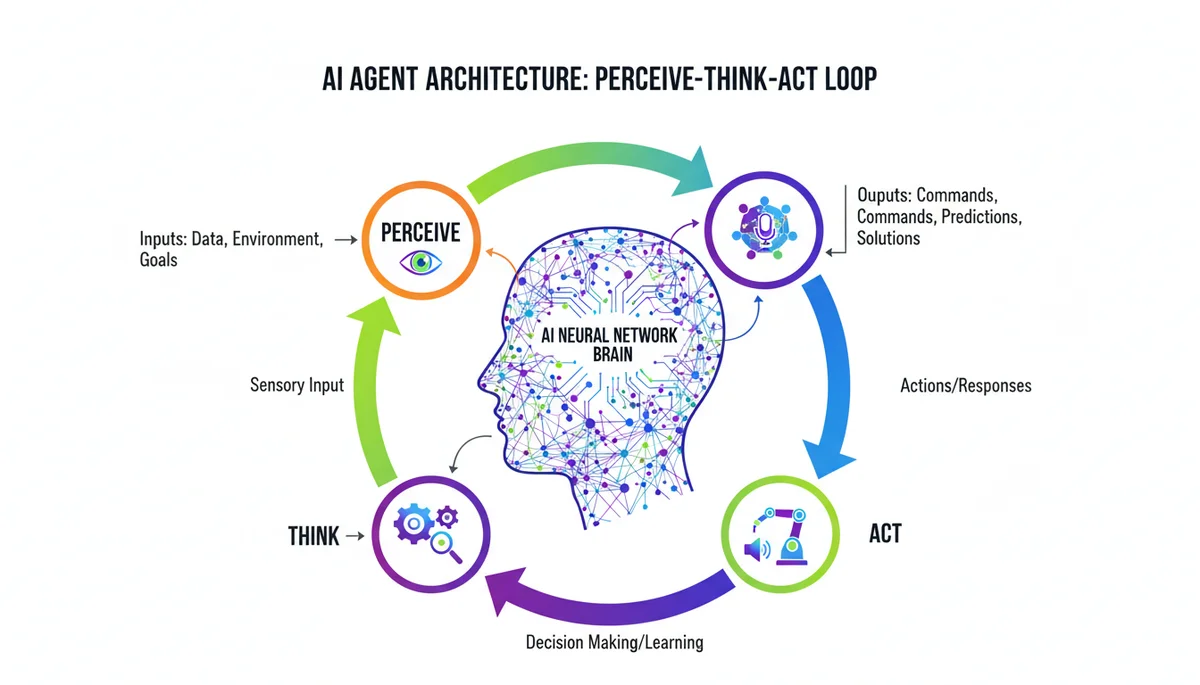
Artificial intelligence has evolved from science fiction into practical technology transforming how businesses operate and make decisions. At the heart of this revolution lies the AI agent: an autonomous software entity that perceives its environment, processes information, and takes actions to achieve specific goals. Understanding what is an AI agent and how these intelligent systems work is essential for organisations seeking to leverage AI's transformative potential in today's competitive landscape.
The Definition of an AI Agent
So, what is an AI agent? At its most fundamental level, an AI agent is an autonomous computational entity that perceives its environment through sensors or data inputs, processes this information using intelligent algorithms, and executes actions to achieve predetermined objectives without requiring constant human supervision. Unlike traditional software programmes that follow rigid, predetermined instructions, AI agents possess the capacity to learn, adapt, and make independent decisions based on their observations and experiences.
AI agents possess four defining characteristics: Autonomy (operating without direct human control), Reactivity (perceiving and responding to environmental changes), Proactivity (taking initiative toward goals rather than merely reacting), and Social ability (interacting with other agents, systems, or humans).
The intelligence within AI agents derives from machine learning, natural language processing, computer vision, and reasoning algorithms. These technologies enable pattern recognition, contextual understanding, outcome prediction, and continuous performance improvement.
Key Capabilities of AI Agents
Environmental Perception
AI agents continuously monitor their environment through sensors, data streams, APIs, and user interfaces. Advanced capabilities include computer vision, natural language understanding, and sensor fusion for comprehensive environmental awareness.
Intelligent Decision-Making
AI agents evaluate information against goals using rule-based systems, probabilistic reasoning, optimisation algorithms, and neural networks. Decision-making sophistication ranges from simple reflexes to complex strategic planning.
Learning and Continuous Improvement
Through machine learning, agents improve performance without explicit reprogramming. Supervised learning recognises patterns from examples, unsupervised learning discovers hidden structures, and reinforcement learning optimises behaviour through trial and error.
Natural Language Communication
NLP capabilities enable fluid human-agent interaction, including understanding context and intent, extracting information from text, generating appropriate responses, and maintaining conversational context.
What are the Types of AI Agents?
Understanding these types of AI agents helps organisations select appropriate approaches for their needs:
Simple Reflex Agents
Operate on condition-action rules without considering history. Examples include thermostats, spam filters, and basic chatbots. They excel in well-defined environments but struggle with context-dependent scenarios.
Model-Based Reflex Agents
Maintain internal environmental models, tracking unobservable aspects. Applications include autonomous vehicles tracking occluded objects and smart home systems remembering preferences.
Goal-Based Agents
Act to achieve specific objectives, evaluating action sequences. Examples include navigation systems, game-playing AI, and task scheduling systems requiring strategic planning.
Utility-Based Agents
Handle multiple objectives by assigning utility values to outcomes, enabling trade-off analysis. Applications include recommendation systems, resource allocation, and financial portfolio management.
Learning Agents
The most advanced types of AI agents, incorporating learning mechanisms for continuous improvement. They adapt through experience, discovering better strategies. Examples include recommendation engines, adaptive control systems, and game-playing agents like AlphaGo.
How Do AI Agents Work?
AI agents function through a continuous "sense-think-act" cycle:
Perception
Agents gather environmental information through sensors, APIs, databases, and user inputs. Raw data undergoes preprocessing to extract features, filter noise, and identify patterns relevant to decision-making.
Knowledge Representation
Agents maintain internal representations of their environment, goals, and knowledge using symbolic representations (logical rules, ontologies) or subsymbolic representations (neural network weights, statistical models).
Reasoning and Decision-Making
The agent's reasoning engine evaluates potential actions using rule-based reasoning, search algorithms, probabilistic reasoning, machine learning models, and optimisation algorithms.
Action Execution
Agents execute selected actions through APIs, database operations, user interfaces, or motor controls. Execution monitoring detects failures and triggers error recovery when needed.
Learning and Adaptation
Learning agents improve through feedback cycles: executing actions, observing outcomes, receiving feedback, updating internal models, and applying improvements to future decisions.
Real-World AI Agent Examples
Virtual Personal Assistants
Siri, Google Assistant, and Alexa exemplify AI agents serving millions daily. They understand voice commands, execute actions, and learn user preferences for personalised experiences.
Autonomous Vehicles
Self-driving cars use multiple sensors to perceive surroundings, plan safe routes, and execute precise vehicle control in real-time.
Healthcare Diagnostic Agents
Systems like IBM Watson Health analyse patient data, medical imaging, and literature to generate diagnostic recommendations.
Financial Trading Agents
Algorithmic trading systems monitor market conditions, identify opportunities, assess risk, and execute trades at speeds impossible for humans.
Customer Service Chatbots
Conversational agents handle inquiries using natural language processing, access knowledge bases, and maintain context throughout interactions.
Recommendation Engines
Netflix, Amazon, and Spotify employ AI agents analysing user behaviour to deliver personalised recommendations.
The Future of AI Agents in the Workplace
Understanding the future of AI agents is critical for organisations preparing for digital transformation.
Ubiquitous AI Assistance
Future workplaces will feature personalised AI assistants as standard tools, managing schedules, prioritising tasks, automating routine work, and providing decision support tailored to individual work styles.
Autonomous Business Processes
Sophisticated agents will manage entire workflows from supply chain orchestration to customer relationship management with minimal oversight.
Enhanced Collaborative Intelligence
AI agents will augment rather than replace human capabilities. Humans provide creativity and ethical judgement whilst agents contribute data processing and rapid computation.
Continuous Learning and Predictive Operations
Agents will capture knowledge from every interaction and shift from reactive to predictive operation, anticipating equipment failures, customer dissatisfaction, and market changes before they occur.
Transform Your Business with Intelligent AI Agents
The age of AI agents has arrived, offering unprecedented opportunities for organisations embracing intelligent automation. Understanding what is an AI agent is just the beginning. Real value comes from strategic implementation that solves business challenges, enhances efficiency, and creates competitive advantages.
At Agentive, we specialise in creating bespoke AI agent solutions tailored to your unique requirements. Our team combines cutting-edge AI expertise with practical industry experience, delivering measurable results across professional services, healthcare, finance, retail, and manufacturing sectors.
March 2026 Update
The AI agent landscape has evolved significantly since mid-2025. In early 2026, frontier models now support extended thinking, computer use, and multi-step tool orchestration out of the box. AI agents are no longer experimental; they are being deployed in production across finance, legal, healthcare, and professional services. The key shift is from "chatbot assistants" to fully autonomous agents that complete end-to-end workflows with minimal human oversight.
Related: Explore the AI Employee Cluster
- What Is an AI Employee? — Agentive’s AI Operation Engine pillar: single-tenant, AWS Sydney hosted, designed for APRA, ASIC and TPB aligned Australian finance professionals.
- AI Employee for Bookkeepers — Xero reconciliation, BAS, GST, AR/AP, multi-file health checks.
- AI Employee for Accountants — multi-client management, white-label reports, practice CRM.
- AI Employee for Financial Advisors — SOA drafting, onboarding, ASIC RG 255 aligned (early access).
- What Is an AI Employee? — Australian Business Guide — the definitive category guide.
Ready to Leverage AI Agents?
Contact Agentive today to begin your AI agent journey.